Why Cross-Border Customer Service Fails: Language Barriers & Domain Blocking Solved
In domestic e-commerce, customer support is predominantly an organizational and conversational challenge. But when your business expands overseas into regions like Southeast Asia, Latin America, the Middle East, or Eastern Europe, customer support transforms into a complex networking and infrastructure problem.
The Hidden Killer: Regional ISP Filtering & Domain Pollution
Many cross-border sellers discover this bitter reality: their Shopify store is running, advertisements are spending thousands of dollars per day, but live chat inquiries suddenly drop to zero.
Why does this happen?
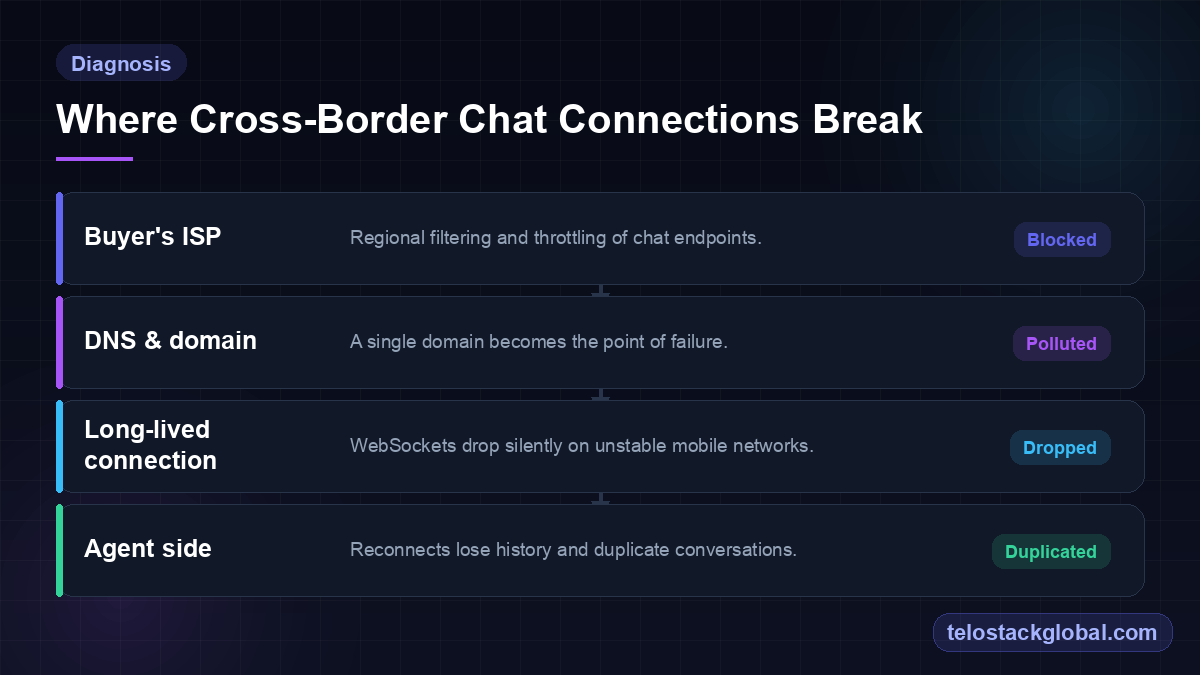
- Aggressive Firewall Interception: Local telecom providers and regional ISPs frequently block or throttle communication endpoints, WebSocket connections, or third-party customer service domains without warning.
- Session Interruption: When an un-resilient chat domain is flagged or polluted, ongoing customer conversations are instantly severed. High-intent shoppers waiting for payment verification are stranded, resulting in abandoned orders.
- Code Modification Nightmare: When a domain gets blocked, standard software forces merchants to manually edit website templates, re-embed new scripts, and wait for DNS propagation—losing hours or days of crucial sales.
The Architectural Fix: Dual-Tier Domain Pool & Hot-Switching
To eliminate single-point-of-failure vulnerabilities, modern enterprise architectures implement a Dynamic Domain Pool with Edge Hot-Switching.
Here is how platforms like TeloStack Global maintain 99.9% uptime:
- Decoupled Ingestion Endpoints: Customer-facing widget scripts communicate with an Anycast edge proxy layer rather than a single static IP or domain.
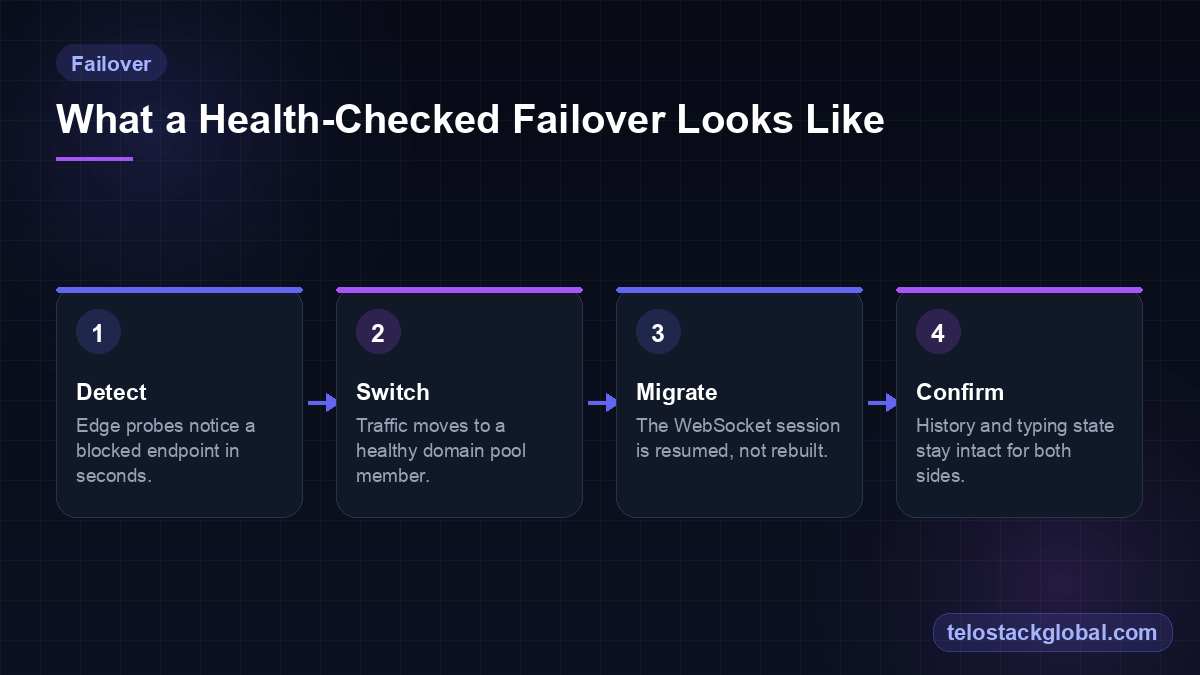
- Zero-Downtime Connection Migration: If an active endpoint experiences degradation or regional blocking, the client SDK automatically falls back to standby routing channels via WebSocket keep-alive handshakes. Ongoing chats stay connected with zero lost messages.
- 0 Code Changes for Merchants: The underlying transport layer handles domain self-healing automatically. Store owners never need to re-touch their theme code or update embedded scripts.
How to Tell Whether Regional Blocking Is Already Happening
Blocking rarely announces itself with a clean error. It usually shows up as a quiet, unexplained drop in conversations. Look for these five signals:
- Chat volume falls in one country while ad spend, sessions and orders stay flat. If traffic arrives but conversations do not, the widget is probably not loading for that audience.
- Connect rates drop on mobile but hold on desktop. Mobile carriers apply different filtering rules than fixed-line ISPs, so the mobile share of your market is the first casualty.
- Buyers describe the symptom, not the cause. "The chat button does nothing", "it spins forever", "I sent a message and nobody answered" are all classic blocked-endpoint reports.
- Sessions disappear mid-conversation. Agents see a thread open with no reply and the buyer never returns. That is a dropped long-lived connection, not a rude customer.
- It works perfectly for you. Your office connection is rarely the one being filtered, which is why these problems survive internal testing for weeks.
Four Failure Modes That All Look Like "The Chat Is Down"
Cross-border chat failures get misdiagnosed because four very different problems produce the same support ticket. Treating them as one issue is why so many teams spend months on the wrong fix.
1. DNS interference and domain reputation
A single chat domain is a single point of failure. Once it is flagged, throttled or poisoned in a region, every store using that domain loses contact with buyers in that region at the same moment. Nothing in your theme code changed, which is exactly what makes it so confusing.
2. HTTP requests fail politely; WebSockets fail silently
A blocked image returns an error your monitoring can see. A long-lived WebSocket connection often just stops receiving frames. The widget still looks connected, the agent still looks idle, and the conversation is already dead. Any platform that relies on a single persistent connection without health checks and migration is exposed here.
3. Third-party script and CDN blocking
If your chat widget loads its JavaScript from a shared public CDN, you inherit that CDN's regional availability. A domain that is fine in Frankfurt can be unreachable in Ho Chi Minh City. The result is a widget that never boots: no error message for the buyer, no event for you.
4. TLS interception and SNI filtering
Some networks inspect the SNI field of the TLS handshake to decide what to block. Because the hostname is visible before any encryption is established, swapping certificates does not help. The only robust answer is the ability to serve the same experience from multiple healthy endpoints.
Diagnosing It in 20 Minutes
Before buying anything, confirm the failure is network-level rather than configuration-level. Five checks get you there:
- Ask three buyers in three countries to open your store with DevTools open. Have them filter the network tab by "ws" and report whether the connection shows as pending, closed, or blocked.
- Compare your chat domain against a control domain. If a well-known site loads for the same buyer but your chat host does not, the problem is the host, not the buyer's connection.
- Watch the WebSocket close code. A clean 1000 close is a normal disconnect. Repeated 1006 errors point to a connection being cut by the network rather than by the application.
- Test mobile data against Wi-Fi in the same location. A widget that loads on Wi-Fi and fails on a carrier network is being filtered at the carrier level.
- Check whether the script loads at all. If the widget's JavaScript request never completes, translation and routing quality are irrelevant — the buyer never reaches your agents.
Why Bigger Servers and More Bandwidth Do Not Help
Blocking is not a capacity problem, so scaling up does not solve it. Adding CPU to one endpoint just gives you a faster unreachable endpoint. The failure is about reachability and identity, and it has three practical consequences:
- One domain means one blast radius. Every market shares the fate of the least reachable region.
- Re-embedding is not a recovery plan. If the fix requires editing your theme and waiting for DNS propagation, your downtime is measured in hours or days, not seconds.
- Polling fallbacks trade reliability for load. Falling back to short HTTP polls keeps some conversations alive while multiplying request volume exactly when the network is least healthy.
What Good Looks Like: A Health-Checked Failover
A resilient architecture separates where your store lives from where your chat connects. The widget talks to an edge layer that continuously probes the endpoints available to it and migrates live sessions when an endpoint degrades.
Measure these five numbers before and after any infrastructure change, by region rather than globally:
- Chat connect success rate per country and per device type, segmented by carrier where possible.
- Session drop rate — the share of conversations that end without an agent reply or a buyer exit message.
- 95th percentile message latency, measured from send to delivery on both sides.
- Mean reconnect time after an endpoint change.
- Chat-initiated to order conversion — the only metric that proves reliability is doing commercial work.
A Practical Remediation Checklist
- Inventory the endpoints your widget depends on. List every hostname: script host, API host, WebSocket host and any third-party CDN.
- Remove shared public CDNs from the critical path. Self-host the widget loader so buyer reachability does not depend on a third party's regional footprint.
- Serve the transport from a domain pool, not a single host. Keep standby endpoints warm rather than theoretical.
- Add health probes from the regions you sell into. Global averages hide regional outages; probe from the buyer's perspective.
- Make session migration a product feature. A failover that loses message history converts a technical win into a customer complaint.
- Keep a rate-limited long-poll fallback for hostile networks so it degrades gracefully instead of amplifying load.
- Instrument connect failures as customer-visible events. If the widget cannot reach the edge, that belongs on the same dashboard as your response times.
- Re-test quarterly by market. Filtering policies change quietly; your monitoring should catch it before your buyers do.
Combined with Sub-Second AI Translation
Once high-availability network connectivity is guaranteed, the second layer of customer service failure—the language barrier—is dismantled.
By integrating a real-time semantic translation engine directly on the server edge, message payloads are decoded, translated across 28+ languages (Spanish, Arabic, Russian, Portuguese, Vietnamese, Japanese, etc.), and delivered in under 500ms.
FAQ: Cross-Border Chat Reliability
What is domain pollution in live chat?
Domain pollution is the gradual loss of reachability of a specific hostname in specific regions. It usually develops when a domain is shared by many sites, appears on blocklists, or is throttled by regional network policy. Buyers experience it as a widget that never loads, while the site itself appears healthy.
Can a VPN solve this for my buyers?
No. You cannot ask a shopper who is trying to buy a $40 product to install a VPN. Reliability has to come from your infrastructure choosing a reachable endpoint, not from your customer working around the problem.
How fast should a chat platform fail over?
Detection should be measured in seconds and migration should be transparent to both sides. If your recovery plan involves editing theme code or waiting for DNS propagation, it is a maintenance procedure rather than a failover capability.
Do I need to change my theme code when an endpoint changes?
No — and you should treat that as a hard requirement when evaluating vendors. The script you embed should be stable; which endpoint it talks to is an implementation detail your provider manages.
Conclusion
High-converting cross-border businesses treat their customer service infrastructure with the same rigor as their payment processing. With resilient domain auto-healing and seamless AI multilingual translation, your global store is protected against lost sales and brand churn 24/7.
Related reading
Building high-availability communication infrastructure