How to Provide 28+ Languages Live Chat for Global Stores Without Hiring Expensive Staff
Selling globally in 2026 is easier than ever thanks to modern logistics, localized payment gateways, and international ad networks. However, when foreign shoppers encounter questions about sizing, international delivery times, or custom duty policies, a massive communication barrier surfaces: language.
According to recent CSA Research studies, 76% of online consumers prefer purchasing products with information in their native language, and over 40% will outright abandon their shopping cart if pre-sale support is only available in English or has noticeable communication friction.
The Traditional Multilingual Dilemma
Historically, cross-border e-commerce brands faced two unappealing choices:
- Hire Dedicated Native Agents: Employing native speakers for Spanish, French, Russian, Arabic, German, and Japanese requires budget, payroll complexity, and 24/7 shift scheduling. For small and mid-sized businesses, this commonly costs upwards of $2,500 per agent per month per language.
- Rely on Clunky Manual Copy-Pasting: Customer service agents constantly copy customer messages into Google Translate or DeepL, then copy translated replies back into live chat. This introduces 30-60 second delays, disjointed conversations, and clumsy errors that erode buyer trust.
The Modern Solution: Real-Time Bi-Directional AI Translation
Modern SaaS platforms like TeloStack Global bridge this gap by placing a sub-second neural translation engine directly into the live duplex communication stream.
Here is how the workflow operates under the hood:
- Automatic Language Detection: When a shopper in Brazil or Madrid opens your web widget and sends a message in Portuguese or Spanish, the system detects the locale instantly.
- Instant Agent Translation: The customer service agent sees the original message accompanied by an instantaneous translation in their native operating language (such as English or Chinese).
- Natural Local Delivery: When the agent types a reply, the translation core converts the text into fluent, context-aware Portuguese or Spanish with proper e-commerce terminology before it reaches the buyer's screen.
Key Advantages of AI-Powered Live Chat
1. 0 Extra Headcount Required
Your existing support team can effortlessly handle customer inquiries from Tokyo, Berlin, Riyadh, or Mexico City without taking foreign language classes or hiring regional specialists.
2. Sub-Second Response Times
Because translation occurs within the WebSocket payload pipeline, response latency is virtually instantaneous (under 50ms for message delivery and under 800ms for semantic translation), preserving the conversational rhythm critical for impulsive e-commerce checkouts.
3. OCR Image and Screenshot Translation
Overseas buyers frequently take screenshots of error messages, banking receipts, or size charts. Modern multilingual tools include built-in OCR (Optical Character Recognition) to translate foreign screenshot text in 1 click directly inside the chat window.
Ensure your live chat widget automatically synchronizes customer tags (buyer country, cart value, and browsing URL). When an agent receives an inquiry in Arabic or Spanish, knowing what page they are browsing allows for instant tailored coupon offers.
How to Embed in 3 Minutes
What "28+ Language Coverage" Actually Means
Vendor language counts are marketing numbers until you map them to your own markets. Before comparing platforms, write down the four or five locales that generate your traffic and revenue, then check how each option handles them in practice:
- Does translation cover the buyer's real dialect and register? Brazilian Portuguese and European Portuguese differ. So do Gulf and North African Arabic. Ask for a sample translated from a real ticket in your catalog.
- Are product and policy terms protected? Model names, SKUs, sizes and return-window language should pass through translation unchanged. That requires a glossary, not just a language model.
- Does coverage apply on every channel? Translation that works in the web widget but not in Telegram or mobile chat splits your quality standard in two.
- Is there an escalation path for nuance? Legal, compliance and complaint threads still need a human who can read the original message.
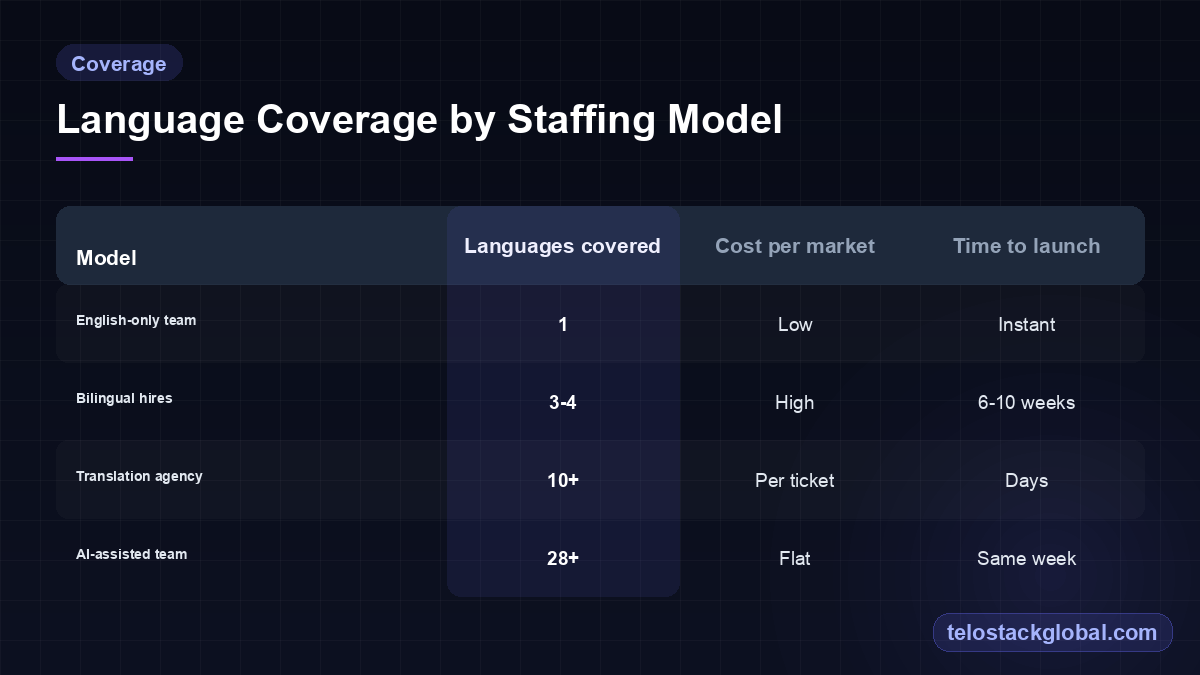
The Four Coverage Models, Priced Honestly
Most global stores end up combining two of these. Knowing the trade-offs makes the combination a decision instead of an accident:
- English-only team: cheapest and instant, but it converts only the share of buyers who are comfortable in English. Pre-sale questions in other languages go unanswered.
- Bilingual hires: excellent quality in three or four languages, with a hiring cycle of six to ten weeks per role and coverage that collapses on nights and holidays.
- Translation agency on demand: broad language reach with per-ticket cost and slow turnaround — workable for email, poor for live chat where the buyer is waiting in a checkout flow.
- AI-assisted single-language team: flat cost across 28+ languages and the same headcount, with human review concentrated on high-value or sensitive threads.
Keeping Translation Accurate for Your Catalog
Translation quality in e-commerce is mostly a configuration problem. Four controls get you most of the way:
- Build a glossary before you launch. Add product names, SKUs, sizes, payment methods and return policies with their approved translations per language.
- Review the first 200 conversations per market. Fix mistranslations at the glossary level rather than correcting the same phrase every week.
- Keep both languages visible to agents. Agents should see the original message and the translation, so they can spot a bad translation on a high-value order.
- Tag conversations by locale automatically. Without locale tags you cannot tell whether Spanish is underperforming because of translation quality, staffing or demand.
Rolling Out Market by Market
Launching 28 languages at once is the fastest way to lose control of quality. Sequence it:
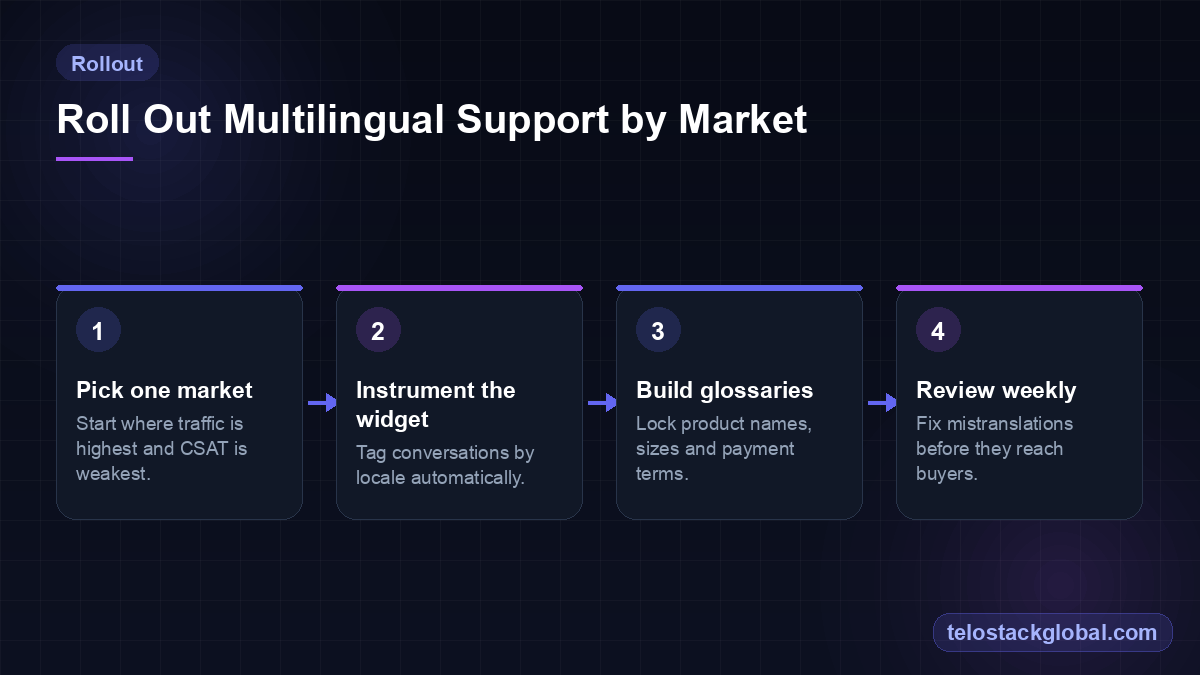
- Week 1: enable the highest-traffic market and a glossary for that language only.
- Week 2: review conversations, fix glossary entries, confirm first-response time did not regress.
- Week 3-4: add the next two markets and introduce routing rules so agents are not pulled across too many languages at once.
- Ongoing: track CSAT and refund/dispute rates per locale, not globally. Locale-level reporting is what reveals whether translation is helping or just sounding fluent.
Common Objections, Answered Honestly
- "Machine translation will sound robotic." Generic translation does. Glossary-controlled, context-aware translation does not — but it needs the configuration work described above.
- "Buyers will notice we are not native." Buyers mostly notice whether their question is answered quickly and correctly. Fast, accurate, translated support beats slow, perfect English.
- "What about sensitive complaints?" Route them to human review. The point of translation is to remove 80% of the routine load, not to hide the human team.
- "Is this cheaper than hiring?" Compare like for like: one bilingual hire per language per shift versus a flat platform cost. For most stores under ten languages, the arithmetic is not close.
How to Embed in 3 Minutes
Modern solutions no longer require complex server setups. Embedding a live chat widget onto Shopify, WordPress/WooCommerce, Shoplazza, or custom React/Vue sites is as simple as inserting one line of JavaScript snippet:
Once embedded, your floating customer support widget is immediately online, capable of welcoming international shoppers in their local dialect.
FAQ: Multilingual Live Chat for Global Stores
How many languages can a single agent realistically handle?
With real-time translation, one agent can work conversations across every supported language at once, because they read and write in their own native language. The practical limit is context, not vocabulary: keep per-agent language focus to a handful of markets if you sell complex products with region-specific rules.
Do I still need a native speaker on the team?
Yes — for sensitive threads, legal and compliance conversations, and quality review. Native speakers shift from answering everything to reviewing the exceptions, which is a much smaller and more predictable commitment.
Will translated chat hurt conversion?
Measured globally, the opposite is usually true: pre-sale questions that previously went unanswered become resolved conversations. Track conversion per locale before and after enabling translation so you can attribute the change correctly.
Does translation work across Telegram and external channels too?
It should, and this is a key selection criterion. If translation only applies to the website widget, buyers who prefer Telegram or mobile channels still cannot be served in their own language. Translation must sit on the shared inbox layer, not on a single channel.
Conclusion
Breaking language barriers is no longer a luxury reserved for multi-billion dollar enterprises. By utilizing AI-powered bi-directional translation and omnichannel aggregation, any cross-border brand can deliver localized, 5-star customer experiences worldwide while drastically cutting support costs.
Related reading
Insights on international trade & communication SaaS