Best Multilingual Customer Support Software for Global Businesses in 2026
In 2026, scaling a global business isn't just about localized marketing or setting up international logistics—it's heavily dependent on how effectively you can communicate with your customers in their native languages. Entering new markets like Latin America, the Middle East, or Southeast Asia brings immense opportunities, but also the daunting challenge of managing customer service across linguistic barriers. Choosing the right multilingual customer support software is critical for converting inquiries into sales and providing post-purchase assistance that retains customers for the long term.
This comprehensive guide delves deeply into what makes a robust multilingual customer support software platform, the core challenges global teams face, a detailed comparison of modern approaches, and ultimately how to choose the best solution for your cross-border enterprise.
1. What to Look for in Multilingual Customer Support Software
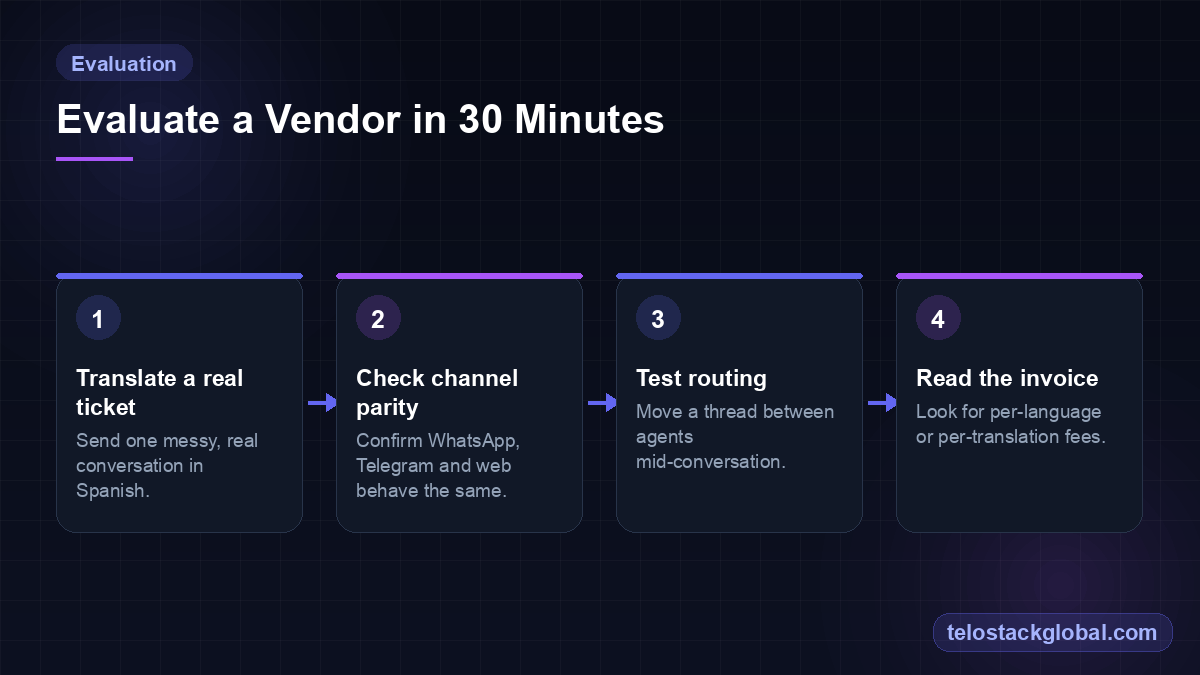
As e-commerce becomes increasingly borderless, traditional English-only helpdesks simply cannot meet the expectations of modern consumers. When searching for top-tier multilingual customer support software, businesses need to evaluate platforms based on several critical criteria:
- Translation Accuracy and Speed: The translation should be culturally aware, contextually accurate, and instantaneous to maintain a natural conversation flow.
- Omnichannel Capabilities: Customers across different regions prefer different communication channels, whether it's web chat, Telegram bots, or direct mobile links.
- Agent Efficiency Tools: Features like multi-agent routing, automated responses, and unified inboxes that help agents handle tickets effortlessly.
- Infrastructure Resilience: Cross-border communication requires a solid network foundation that won't drop connections due to regional firewall blocking or poor internet infrastructure.
- Scalability and Pricing: The software must scale cost-effectively as your team grows or your ticket volume spikes during peak shopping seasons.
The right software doesn't just translate words; it bridges the gap between your brand and your international customers, making them feel heard, understood, and valued.
2. The Core Challenge: Real-Time Translation vs Pre-translated Templates
Historically, businesses trying to offer multilingual support relied heavily on static, pre-translated templates. While this approach is relatively straightforward to implement for common queries like "Where is my order?" or "How do I return an item?", it falls completely flat when a customer has a unique, nuanced issue.
Pre-translated Templates: This method requires hiring native speakers to manually translate hundreds of possible responses. It is inflexible, hard to maintain, and creates a robotic customer experience. If a user asks a question slightly outside the predefined scope, agents are left scrambling or resorting to clumsy external translation tools, which increases resolution time and customer frustration.
Real-Time Semantic Translation: Modern multilingual customer support software leverages advanced AI and neural machine translation to instantly interpret incoming messages and translate agent responses back into the customer's native language. This dynamic approach allows a single English-speaking (or any other language) support team to communicate fluidly with customers worldwide, without the latency or awkwardness of switching between tabs to use Google Translate. Real-time translation captures context, slang, and sentiment, offering a vastly superior customer experience.
For any serious global business in 2026, real-time, bidirectional translation is no longer an optional feature—it is a baseline requirement.
3. Comparison of Approaches
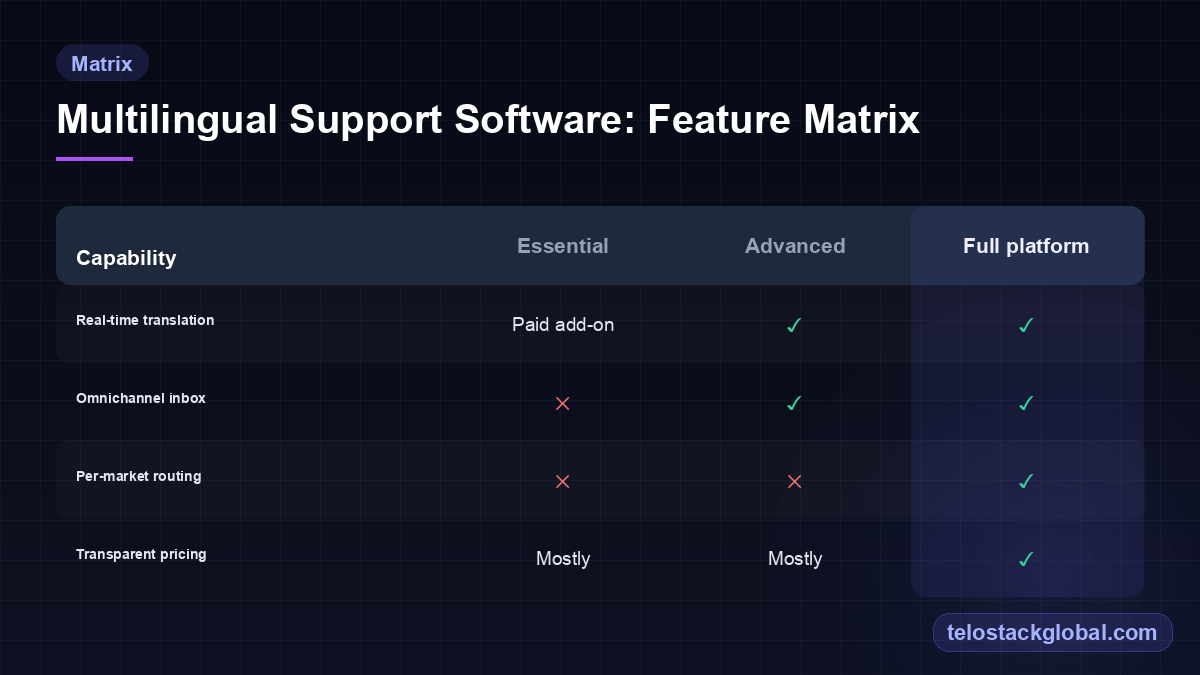
When selecting a solution, you generally have three architectural approaches to choose from. Let's compare them:
Traditional Helpdesk Tools with Translation Plugins
Many legacy platforms offer multilingual capabilities as an add-on or a third-party plugin. While this might seem convenient if you are already locked into a specific ecosystem, the integrations are often clunky. Translation happens as a secondary process, adding latency. Furthermore, these plugins frequently charge per character translated, which can cause costs to spiral out of control during busy periods.
Standalone AI Translation SaaS
There are specialized tools designed purely to sit on top of your existing communication channels and translate text. While the translation quality is usually excellent, these tools do not offer the underlying support infrastructure (like ticketing, routing, or analytics). Businesses are forced to cobble together multiple software subscriptions, leading to fragmented workflows and potential data silos.
Hybrid All-in-One Multilingual Platforms
The most effective solution for cross-border e-commerce is a hybrid platform built from the ground up with native multilingual capabilities. These platforms integrate enterprise-grade network infrastructure, advanced AI translation engines, and robust helpdesk features into a single, unified interface. This approach eliminates latency, drastically reduces costs, and provides agents with a seamless workflow.
4. Key Features That Matter for Cross-Border Teams
To succeed globally, your multilingual customer support software must possess a specific set of advanced features tailored for cross-border operations.
Real-time Bidirectional Translation
This is the heart of the system. An agent typing in English should have their message instantly delivered to a customer in Arabic, and the customer's Arabic response must instantly appear on the agent's screen in English. The translation engine must be intelligent enough to handle industry-specific terminology and colloquialisms without hesitation.
Omnichannel (Web, Telegram, Mobile Channels)
Global customers have distinct channel preferences. While web chat is ubiquitous, social channels like Telegram and direct mobile chat links are critical for international buyers. A superior platform consolidates all these channels into a single dashboard, applying the same real-time translation rules regardless of the medium.
Multi-agent Routing
As your support volume grows, efficiently distributing the workload becomes crucial. Advanced multi-agent routing ensures that incoming inquiries are instantly assigned to the most appropriate, available agent based on skill level, workload, or specific business logic, minimizing wait times and maximizing resolution rates.
Domain Resilience
This is an often-overlooked but absolutely critical feature. When operating across borders, regional ISPs may inadvertently (or intentionally) block or throttle connections to standard SaaS domains, causing chat widgets to fail or disconnect mid-conversation. Leading software utilizes dynamic domain pooling and Anycast edge networks to ensure zero-downtime connection migration, keeping customer sessions alive even under adverse network conditions.
5. Which Languages Matter Most for Cross-Border E-Commerce?
While English remains the lingua franca of global business, true cross-border success requires deep localization. Depending on your target markets, supporting specific languages can drastically boost conversion rates and customer satisfaction. The most critical languages for e-commerce expansion in 2026 include:
- Spanish: Essential for accessing the rapidly growing Latin American e-commerce market, as well as a massive demographic in North America.
- Arabic: Critical for the affluent and highly digital Middle Eastern markets (MENA region), requiring software that flawlessly handles Right-to-Left (RTL) text rendering.
- Russian: Important for Eastern Europe and Central Asia, representing a vast, diverse consumer base.
- Vietnamese & Thai: As Southeast Asia continues its explosive digital growth, localizing for Vietnam, Thailand, and Indonesia is non-negotiable for brands seeking high-volume sales.
- Portuguese: Crucial for dominating the Brazilian market, one of the largest economies in Latin America.
A top-tier multilingual customer support software should support dozens of languages out-of-the-box, ensuring you can pivot to new markets effortlessly.
6. Pricing Models: Per-Seat vs Flat Fee vs Usage-Based
Understanding the pricing models of different software providers is essential for maintaining a healthy ROI.
Per-Seat Licensing
Many traditional platforms charge based on the number of agents (seats). While predictable, this penalizes businesses that need to scale up their support team temporarily during holidays or promotions, leading to unnecessary overhead.
Usage-Based (Pay-per-Translation)
Some tools charge based on the number of words or characters translated. For high-volume e-commerce stores, this model is dangerously unpredictable. A single viral product can result in a massive spike in support tickets, causing translation costs to skyrocket and destroying profit margins.
Flat-Fee / Tiered Subscriptions
The most business-friendly model for multilingual software is a predictable flat fee that includes unlimited translation and a generous number of seats. This allows brands to forecast their operational expenses accurately and scale their customer service without fear of hidden penalty charges.
7. How TeloStack Global Delivers All of the Above
When evaluating the landscape of multilingual customer support software, TeloStack Global emerges as the premier solution engineered specifically for the demands of cross-border e-commerce in 2026.
TeloStack Global provides a unified, highly resilient platform that tackles the hardest challenges of international customer service head-on:
- Lightning-Fast Bidirectional Translation: Utilizing proprietary AI translation engines deployed at the network edge, TeloStack Global delivers sub-500ms translations across more than 28 languages, ensuring conversations feel natural and immediate.
- True Omnichannel Integration: Manage interactions from Web Live Chat, Telegram Bot, and direct links from a single, intuitive interface, all empowered by real-time translation.
- Unbreakable Domain Resilience: TeloStack Global's dynamic domain pooling and automatic hot-switching guarantee that your chat infrastructure remains online, bypassing regional ISP filtering and preventing lost sessions.
- Transparent, Scalable Pricing: We believe in growing with our partners. Our pricing models are designed to eliminate the anxiety of usage-based billing, offering predictable tiers that support unlimited translation for your team.
- Enterprise-Grade Routing: Smart multi-agent routing ensures your support operations remain efficient, regardless of ticket volume or geographical spread.
By consolidating network reliability, advanced AI, and intuitive helpdesk tools, TeloStack Global empowers your support team to act as local experts in every market you serve.
8. Conclusion
Navigating the complexities of international markets demands tools that are as agile and ambitious as your business. The right multilingual customer support software breaks down language barriers, builds profound customer trust, and significantly increases your global revenue. By prioritizing real-time translation, omnichannel support, and infrastructure resilience, you can deliver exceptional customer experiences worldwide.
Don't let language differences or dropped connections cost you another sale. Upgrade your support infrastructure today and connect with your global audience effortlessly.
Related reading
Building high-availability communication infrastructure