AI Customer Service for Cross-Border E-Commerce: How LLM Translation Replaces Expensive Multilingual Staff
The Real Cost of Hiring Multilingual Customer Service Staff
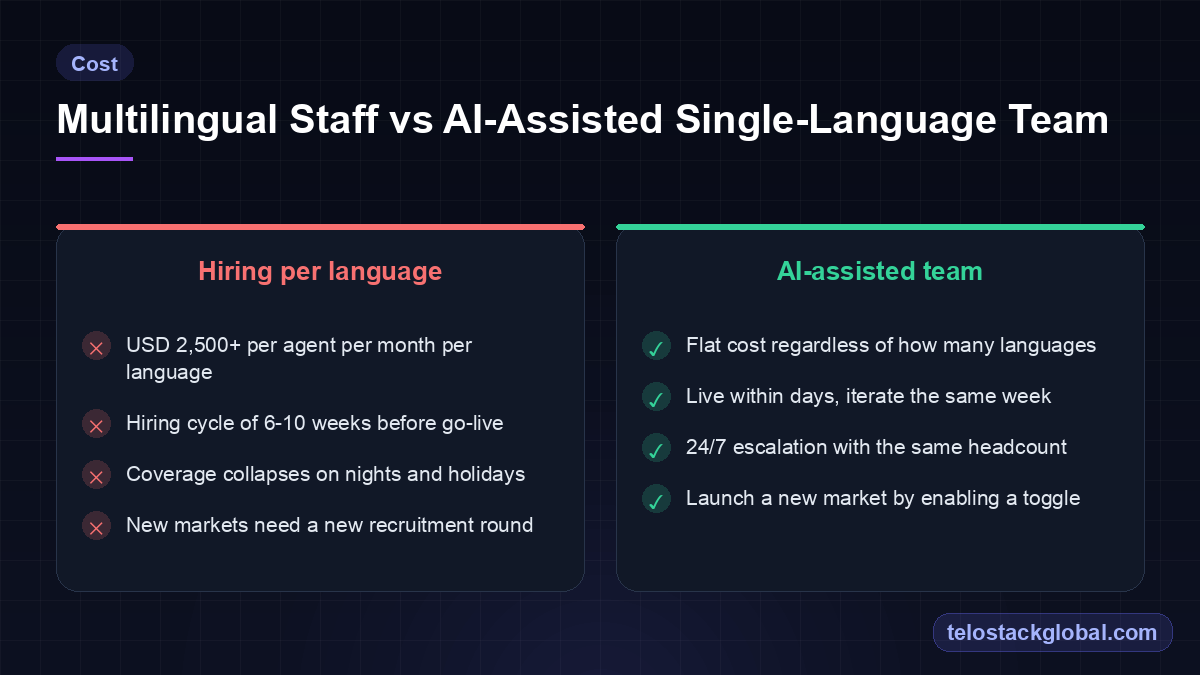
In the fast-paced world of cross-border e-commerce, customer support can either be your strongest competitive advantage or your most crippling expense. When scaling a brand internationally, merchants inevitably face a daunting challenge: the language barrier. Many e-commerce businesses initially try to solve this by hiring native speakers or bilingual agents for each new market they enter. However, the real cost of hiring multilingual customer service staff goes far beyond their hourly wages or monthly salaries. First, there is the sheer difficulty of recruitment. Finding qualified customer support representatives who are fluent in languages like Arabic, Japanese, or Portuguese, and who also understand the nuances of your specific product line, is incredibly time-consuming. You are competing with large tech companies and established multinational corporations for the same small talent pool. This drives up salaries and signing bonuses.
Secondly, managing a distributed, multilingual workforce introduces severe operational overhead. You need managers who can actually evaluate the quality of support being provided in these foreign languages. Training becomes a logistical nightmare when documentation and coaching sessions must be translated. Furthermore, human agents have limited capacity. During peak shopping seasons like Q4, Black Friday, or regional holidays like Ramadan or Singles' Day, ticket volumes can spike unpredictably. Hiring temporary multilingual staff to cover these short-term spikes is practically impossible, leading to long response times, frustrated customers, and lost sales.
Additionally, providing 24/7 coverage in multiple time zones requires at least three shifts per language, meaning you might need to hire four to five agents just to cover a single language round-the-clock. For a mid-sized cross-border seller targeting five different regions, this could mean an immediate requirement of twenty or more specialized support staff. The financial burden quickly becomes unsustainable, directly eating into your profit margins and stifling further international expansion. Ultimately, this traditional approach forces brands to choose between prohibitive costs or abandoning promising global markets altogether due to poor customer experience.
What AI Customer Service Actually Means in 2026
The term "AI customer service for ecommerce" has evolved dramatically over the last few years. In the early 2020s, it was synonymous with rigid, decision-tree chatbots that frustrated consumers more often than they helped. These legacy bots could only respond to pre-programmed keywords and forced customers through endless loops of irrelevant menus. Today, in 2026, AI customer service means something entirely different and profoundly more powerful. It is no longer just about replacing the agent with a robot; it is about empowering a single, monolingual agent to seamlessly converse with anyone in the world.
The breakthrough lies in Large Language Model (LLM) powered semantic translation. Unlike older statistical translation engines like traditional Google Translate, which often provided stiff, literal, and sometimes embarrassingly inaccurate translations, LLM-based translation understands context, slang, intent, and cultural nuances. When a customer in Brazil types a colloquial phrase about a delayed shipment, the LLM does not translate it word-for-word. Instead, it extracts the semantic meaning and reconstructs it into perfect, natural-sounding English for your support agent.
When your agent replies in English, the LLM instantly rewrites the response into native-level Brazilian Portuguese, ensuring the tone is polite, empathetic, and culturally appropriate. This shift from "deflection bots" to "augmentation tools" is revolutionizing cross-border e-commerce. It means that your existing core support team, located entirely in your home country and speaking only your native language, can now handle inquiries from over a hundred different countries without any friction. True AI customer service seamlessly blends into the background. The customer feels they are chatting with a local representative who perfectly understands their needs, while the agent feels they are exclusively serving domestic customers.
How AI Translation Works in Live Chat
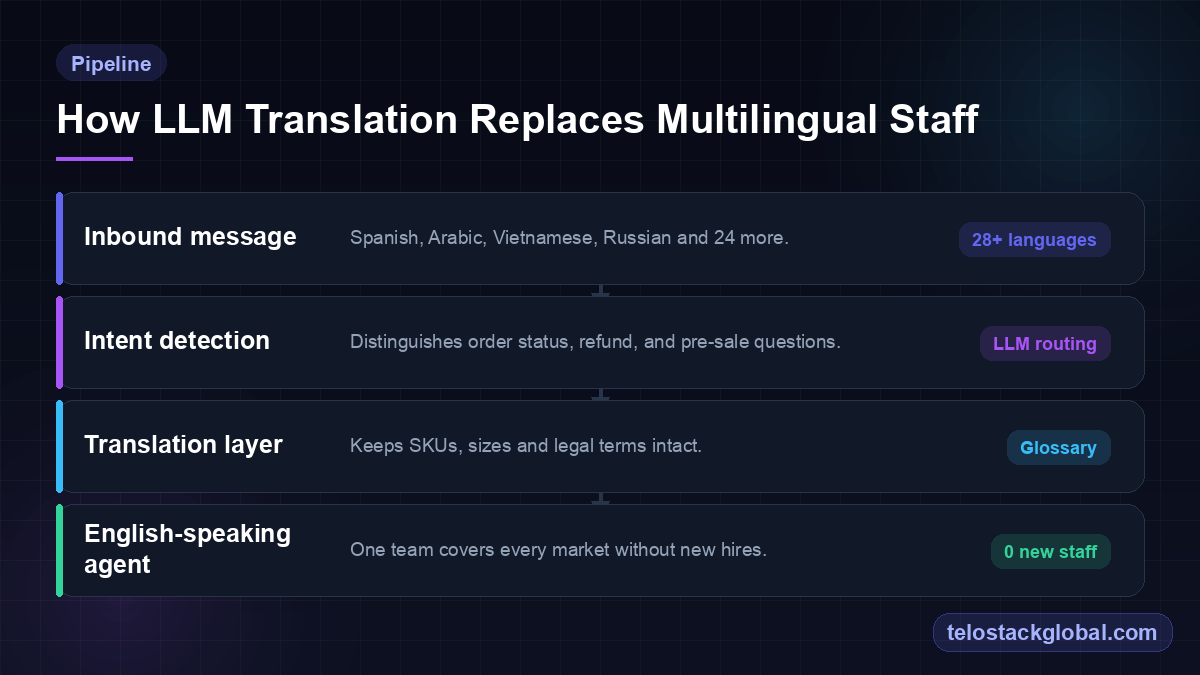
The mechanics of modern AI translation within live chat environments represent a marvel of contemporary software engineering. To truly support cross-border e-commerce, translation must be bidirectional, real-time, and deeply context-aware. Bidirectional means that the translation pipeline flows flawlessly in both directions simultaneously. The customer inputs text in their native language, which is transmitted to the server. The server instantly processes this payload through an LLM, rendering it into the agent's language. The agent reads the text, types their response, and the system translates it back before delivering it to the customer's screen.
All of this must happen in what feels like real-time. E-commerce shoppers have notorious impatience. If a live chat message takes five or ten seconds to translate and deliver, the customer will simply close the tab and buy from a competitor. Leading solutions like TeloStack Global utilize edge computing and highly optimized LLM inference APIs to achieve sub-500 millisecond translation latencies. This speed ensures that the conversational flow remains natural and uninterrupted.
Furthermore, the translation must be context-aware. In e-commerce, certain words can have multiple meanings depending on the product category. For example, the word "charge" could refer to a battery for electronics, a financial transaction, or a shipping fee. Traditional translators often guess wrong. However, an LLM integrated into your customer service platform is aware of the previous messages in the chat history, and it can even be fed context about the specific product page the customer is viewing. This allows the AI to accurately disambiguate terms and provide hyper-accurate translations that prevent costly misunderstandings. The system can also be trained on your brand's specific glossary, ensuring that trademarked terms, product names, and unique return policies are handled consistently across all languages.
28+ Language Support: Which Markets Benefit Most?
The ability to instantaneously communicate across dozens of languages unlocks unprecedented revenue opportunities for cross-border e-commerce brands. With platforms offering seamless support for 28+ languages, merchants can now confidently enter emerging and high-growth markets that were previously deemed too complex due to linguistic fragmentation. One of the primary beneficiaries is the Southeast Asian market. Countries like Indonesia, Vietnam, and Thailand boast massive, rapidly growing middle classes with huge appetites for cross-border goods. However, English proficiency in these regions varies greatly, and local consumers strongly prefer to shop and request support in their native languages. AI translation allows a seller in North America or Europe to instantly offer native-level support in Bahasa Indonesia, Vietnamese, and Thai without hiring a single local employee.
Similarly, the Latin American market, encompassing diverse dialects of Spanish and Portuguese, is experiencing a massive e-commerce boom. Providing localized, culturally nuanced support across Brazil, Mexico, Colombia, and Argentina can dramatically increase conversion rates and customer loyalty. The Middle East, particularly countries like Saudi Arabia and the UAE, presents another highly lucrative opportunity. Consumers in these regions expect premium, personalized service in Arabic. Implementing AI customer service for ecommerce enables brands to cater to these high-value customers effortlessly.
Even within Europe, expanding beyond the UK into markets like Germany, France, Italy, and Eastern Europe requires localized support to overcome consumer hesitation and build trust. By breaking down the language barrier, AI translation effectively democratizes global trade. It allows small and medium-sized enterprises (SMEs) to compete on a global scale, offering a level of customer support that was once the exclusive domain of massive multinational corporations with dedicated regional call centers. Every market with a strong e-commerce ecosystem but distinct linguistic preferences immediately becomes accessible and highly profitable.
AI vs Human Agents: The Hybrid Model That Works
A common misconception regarding AI in customer service is that it is an all-or-nothing proposition—that businesses must choose between purely human agents or fully automated, autonomous AI bots. In reality, the most successful and profitable cross-border e-commerce brands are adopting a powerful hybrid model. This model recognizes the distinct strengths of both human intelligence and artificial intelligence, combining them to deliver an unparalleled customer experience.
In the hybrid model, the AI serves as a powerful "exoskeleton" for the human agent. The human provides the empathy, the complex problem-solving abilities, the emotional intelligence to de-escalate angry customers, and the strategic upselling skills that build brand loyalty. The AI, on the other hand, provides the raw computational power needed for instant linguistic translation, data retrieval, and repetitive task automation. When a customer inquiry comes in from Japan, the human agent does not need to know a single word of Japanese. The AI instantly translates the incoming Japanese message into English. The human agent reads the message, understands the customer's frustration regarding a delayed package, and formulates a deeply empathetic and helpful response in English. The AI then flawlessly translates this response back into polite, culturally appropriate Japanese.
This synergy is incredibly potent. It prevents the robotic, frustrating experiences associated with legacy chatbots, while simultaneously eliminating the astronomical costs of hiring native speakers for every target market. Furthermore, this hybrid approach allows for incredible scalability. Your core team of top-tier, highly trained agents can now handle the entire global ticket volume. You can focus your resources on training these agents to be product experts and brand ambassadors, rather than scrambling to find bilingual staff who might only have mediocre customer service skills. The hybrid model is not about replacing humans; it is about supercharging them, allowing a small, centralized team to act as a massive, globally distributed, hyper-polyglot workforce.
ROI: How Cross-Border Sellers Cut Support Costs by 60%
The financial implications of implementing AI-powered multilingual customer service are nothing short of transformative. When you analyze the Return on Investment (ROI) for cross-border e-commerce sellers, the numbers are staggering. On average, merchants adopting this technology report cutting their total customer support costs by over 60%, while simultaneously improving customer satisfaction scores (CSAT) and reducing ticket resolution times.
To understand this dramatic cost reduction, we must revisit the traditional model. Imagine a brand operating in five distinct linguistic regions. To provide basic 8-hour coverage in each region, they would need a minimum of five specialized bilingual agents. To provide 24/7 coverage, that number jumps to fifteen or twenty. When you factor in salaries, benefits, recruitment costs, training overhead, and management for a distributed team, the annual expense easily runs into the hundreds of thousands of dollars. By switching to an AI translation platform like TeloStack Global, that entire localized workforce requirement is eliminated. The brand can consolidate its support operations into a single, highly efficient team operating out of its headquarters. A team of five highly skilled, monolingual agents, empowered by real-time LLM translation, can handle the exact same global volume—across all five regions, 24/7—at a fraction of the cost.
The savings go directly to the bottom line. But the ROI is not just about cutting costs; it is also about driving revenue. When customers can communicate effortlessly in their native language, conversion rates soar. Pre-sales inquiries are resolved instantly, removing friction from the purchasing process. Post-sales support is handled with empathy and clarity, drastically reducing chargebacks, returns, and negative reviews. Furthermore, the ability to instantly launch support in a new language means brands can test and enter new international markets with virtually zero upfront investment in customer service infrastructure. This agility allows for rapid global expansion, turning customer support from a massive cost center into a strategic driver of international revenue growth. The 60% reduction in support costs is just the beginning; the true value lies in the unlocked global sales potential.
Implementation: Getting AI Customer Service Running in 3 Minutes
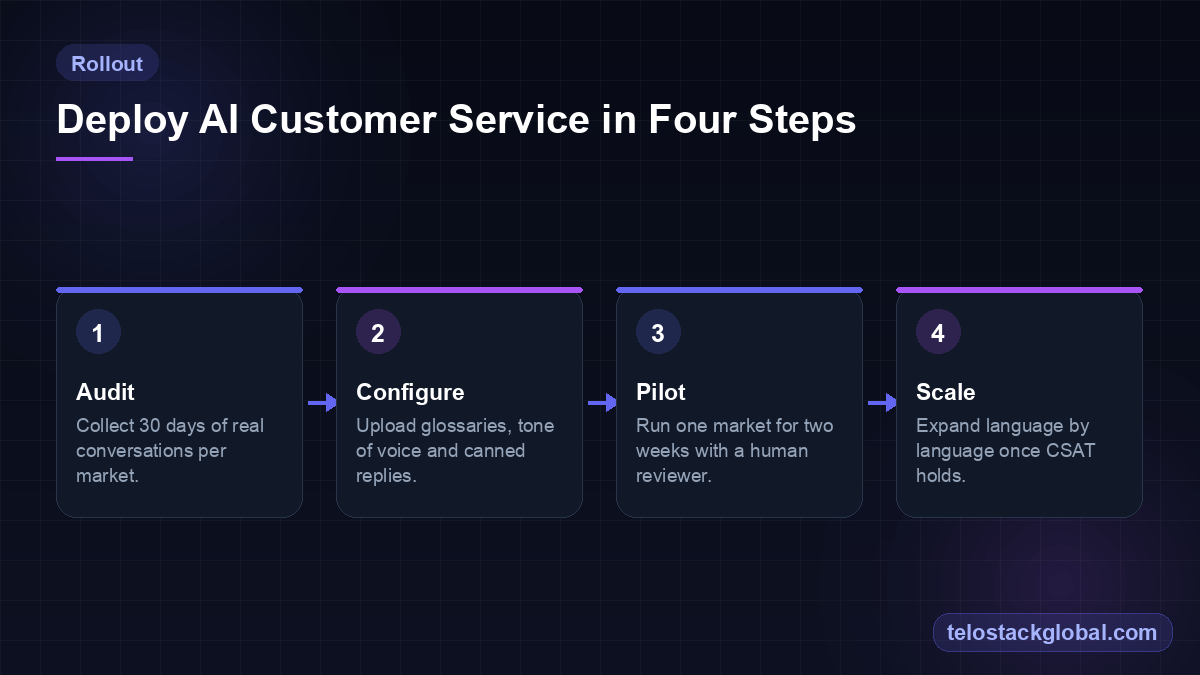
One of the most significant barriers to adopting new enterprise technology is the fear of complex, disruptive implementations. Merchants often dread months of integration work, IT bottlenecks, and the agonizing process of retraining staff. Fortunately, the latest generation of AI customer service for ecommerce is designed specifically for frictionless deployment. Platforms like TeloStack Global have engineered their systems so that a fully functional, multilingual live chat infrastructure can be up and running on your Shopify, WooCommerce, or custom storefront in under ten minutes.
The process typically involves zero coding and requires no specialized technical expertise. It starts with a simple account creation and the generation of a lightweight JavaScript snippet. This snippet is then pasted into your website's header or tag manager—a process familiar to anyone who has ever installed Google Analytics or a Facebook Pixel. Instantly, the live chat widget appears on your site, fully localized and ready to intercept global traffic.
On the backend, your agents log into an intuitive, web-based dashboard that requires virtually no training. The interface resembles standard messaging apps, but with the hidden power of real-time translation built directly into the text input and display fields. There is no need to manually switch languages or click translate buttons; the system automatically detects the customer's language and handles the bi-directional translation seamlessly in the background. Furthermore, these modern platforms come pre-configured with the dynamic domain pooling and edge hot-switching architecture discussed in our previous guides. This means that from day one, your cross-border customer service is not only multilingual but also immune to regional network filtering and domain blocking. This rapid, plug-and-play implementation empowers brands to modernize their global support infrastructure almost instantly, reaping the benefits of AI translation without any of the traditional IT headaches or operational downtime.
Conclusion
In the hyper-competitive landscape of global e-commerce, the businesses that thrive are those that can deliver a localized, frictionless experience to every customer, regardless of their geographical location or native language. Relying on the outdated model of hiring fragmented, multilingual support teams is no longer sustainable. It is too expensive, too difficult to scale, and ultimately leads to inconsistent customer experiences. AI customer service for ecommerce, specifically powered by real-time, context-aware LLM translation, represents a fundamental paradigm shift. It allows you to centralize your operations, drastically reduce overhead costs, and elevate the quality of your support by empowering your best agents to serve the entire world.
By adopting a hybrid model where human empathy is supercharged by artificial intelligence, you can break down the language barrier once and for all. You can enter new markets with confidence, convert international browsers into loyal buyers, and protect your brand's reputation globally. TeloStack Global provides the comprehensive infrastructure needed to make this a reality. Our platform combines sub-second AI multilingual translation with military-grade network resilience and domain auto-healing, ensuring your live chat never drops and your messages are always perfectly understood.
Don't let language limitations or network censorship throttle your international growth. Take the definitive step towards global e-commerce dominance. Transform your customer service from a costly bottleneck into a powerful engine for international expansion.
Related reading
Building high-availability communication infrastructure